
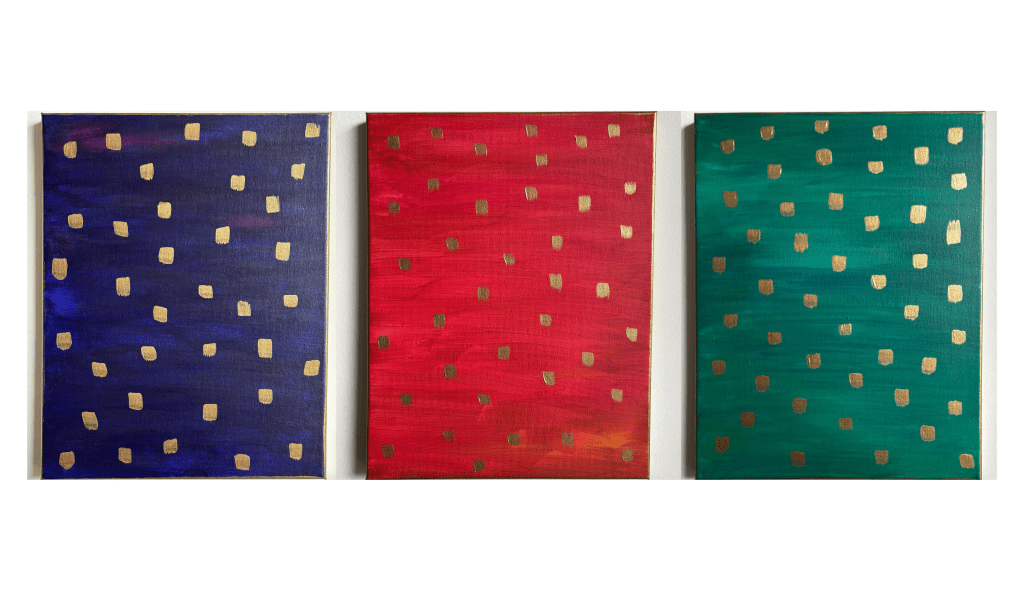
Weaves of Resilience is inspired by multiple women who came before me, and whose resilience I carry on my shoulders when I carry their beautiful saris.
In North India, women often assemble a trousseau when they get married. Saris, one of South Asia’s many traditional outfits, are singular fabrics – usually 6 yards long – draped around the body, that typically make up an important part of the trousseau.
Women from different regions of the subcontinent drape the sari differently since there is no one ‘right’ way to wear it, making it pretty versatile. Saris vary in fabrics for different seasons, in colours for different occasions, and in their weave for different handloom traditions. They are gifted on special occasions, and if one is lucky, inherited from someone who cared for the garment for years.
All saris tell stories. Some stories are woven into the fabric by skilled craftspeople, sharing legends of bravery, festivity, or love in breathtaking imagery. Some saris carry reminders in symbols drawn from nature, like peacocks, elephants, trees of life, mangoes, flowers, and more. Some saris combine beauty with practicality, handcrafted with threads of gold or silver, a garment that can be used to literally store value for the owner. Some modern saris carry stories of personal expression and strength – I’ve come across multiple that are designed to honour the work of those serving vulnerable women and children.
When it came time for my own wedding, I was also encouraged to build a traditional trousseau, to bring along to my ‘new home’. As a feminist and a minimalist, this did not sit right with me – I could not justify this morally, monetarily or emotionally.
However, I also love saris. I always have. I grew up watching my schoolteachers wear airy cotton saris to survive Dubai’s relentless heat, my mother wearing her silks to dinner parties and festivities, and my grandmother draping her everyday saris faster than I could wear my t-shirts and shorts. I was the little girl who draped my mother’s dupattas on myself, and draped handkerchiefs on my dolls while playing house with them.
So instead of buying anything for my trousseau, I asked every influential woman in my life – my mother, grandmothers, aunts and some friends, to gift me a sari they had owned, worn and cherished. I wanted to build this special part of my wardrobe with their stories.
All these amazing women were happy to comply – and not just because it helped make some extra space in their wardrobes. They made sure to gift me saris from different regions of the subcontinent, along with explicit instructions on caring for and storing their precious garments. They let me into their closets, some for the very first time, which felt like a sneak peak into their inner worlds. Each sari was handed over like it was a part of themselves, to be handled with utmost care.
Today, most of these women wear saris only on special occasions, but almost all of them were married into families at a time when wearing a sari everyday was the default, regardless of comfort or choice. Yet, every one of these women stood up for themselves and created a world where I could choose what I wanted to do with my life, how and where I wanted to live, who I wanted to partner with, and how I wanted to dress.
Millions of women in India still do not have the choice to dress the way they want to. Their wardrobes – and lives – are designed by practicality, oppression and oftentimes fear. They do not have access to all the choices and privileges that I do. Yet, they rebel in ways big and small. Women fight everyday to dress how they want, do the work they want to, fall in love with who they want to – just be who they want to be. These are rights I take for granted because the women who came before me paved the way, but I remind myself that none of us is free until all of us are free.
At the same time, I have also learned not to associate my own saris with oppression. Instead, I associate them with the courage of the women who came before me, whose strength and wisdom I have leaned on more than I can remember or ever hope to give back. I associate them with the hard won freedoms they fought for, so I got to be who I wanted to be. I wear them with pride, and I try to wear them often, especially when I’m out in the world.
My saris are some of my most prized possessions today. I could never have afforded the luxury of building this beautiful, colourful, meaningful collection of saris by myself. Without the women in my life, I would never have wanted to, either.
Inspired by these beautiful saris, woven from across decades, from different fabrics and handloom traditions of different parts of India, I painted this triptych.
I tried to build the colours of the canvas into bold, brilliant strokes, as full of life as the women who have inspired them. The gold flecks and borders represent designs, patterns and adornments often found in saris of the subcontinent. I also use gold acrylic generously in my paintings, and naturally gravitated to it for this collection as well.


Let’s have a conversation :)