In 5 words or less- Mixed feelings.
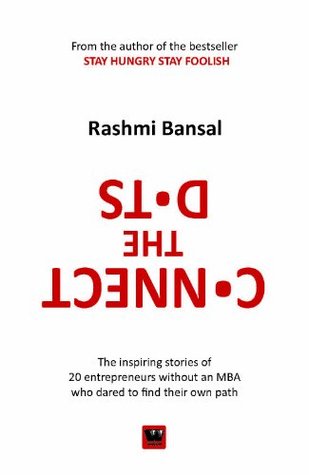
To be honest, I sometimes judge books by their covers. This book’s cover- white, with red upside down print- made me pick it up and start reading it, despite it being the second book in a non-serial series. The book’s title comes from Steve Jobs’ commencement speech at Stanford University (2005) where he said
You can’t connect the dots looking forward, you can only connect them looking backwards.
CtD is about 20 entrepreneurs who chased their dreams, and worked their way up to create veritable empires- all without the sanctimonious MBA.
The stories themselves were quite straightforward. From Dosa Plaza to Su-kam, from Fem Care to Tantra t-shirts, the stories were endearing, and educational to the point where every story ended with an ‘Advice to Young Entrepreneurs’ section. My mixed feelings were more to do with the author’s writing style.
It was great that every story was written in an article style, so I didn’t feel like I was reading a very heavy, biographical book, rather it felt like shots of anecdotes. But that only worked if I actually read the book in those short bits. Since I read the book continuously, it felt too monotonous and… magazine like. Then again, this is my opinion, I guess I asked for it when I picked up a book about 20 success stories.
Be one pointed. Don’t waver and don’t look too far ahead- just go step by step and it comes to you.
– Sunil Bhu, Flander’s Dairy
The stories that stayed with me the most were Prem Ganapathy‘s rise from humble dishwasher to the owner of his own fast food chain Dosa Plaza, R Sriram‘s idea of building Crossword, the bookstore, Saurabh Vyas and Gaurav Rathore‘s political advisory firm which works from the bottom up, Chetan Maini‘s dream vehicle Reva Electric Car company, Abhijit Bansod‘s Studio ABD, Krishna Reddy‘s endearing story of the Prince Dance Group and Kalyan Varma‘s rise as a world renowned wildlife photographer.
There is no shortcut in life, go for details. For any big achievement you need patience and devotion.
-Satyajit Singh, Shakti Sudha Industries
My take-aways from the book:
Hard work, hard work, hard work. It’s said that the harder you work, the luckier you get. When you work hard, that chance just seems to happen to you, or that break that can completely turn your life around. Of course, not everyone who works hard gets a break, and not everyone who get a break has been working hard, but like many of the entrepreneurs in the book, there’s nothing to do but persevere.
Dream, and believe in your dream. You can’t expect to make a 100 crore company if you dream of a 1 crore company. And you certainly can’t make it if you think you will do it all on your own. I think that’s a lesson we sort of forget, mistaking our ambition for over confidence. Overconfidence will let you down, but ambition, and the right attitude, will fuel you.
I believe only ordinary people can do extraordinary things. If people think they are already extraordinary, they will do ordinary things. The attitude, the focus on work comes by thinking we are not great. Because it is all about team work.
– Suresh Kamath, Laser Soft Infosystems
Challenge expectations. No one expected an IIT computer engineer to become a wildlife photographer. No one expects to make money in a business sourcing makhaanas. No one expects a bored housewife to introduce India to its number 1 bleaching cream. It’s about deciding that you will take the road less travelled, and knowing that that will make all the difference.
Doing your own thing is better than sex.
– Ranjiv Ramchandani, Tantra T-shirts
Question everything. How can I serve my customers better? How can I create a smaller, more efficient battery for an inverter? Should I turn my company into an exclusive English Language Center? After questioning, listen to yourself, and you will find the answer within you. You know your business best, you’ve nurtured it, so now evaluate the risk, and take the one that’s going to be worth it.
Instead of asking, ‘Which bank will fund us’, I should ask, ‘Who stands to gain the most by funding us’?”
R Sriram, Crossword
Education is essential. Whether it’s school, college, self study or even the kitchen, education is a key aspect in running a business successfully. Not only must you be educated in your craft, it is also important to learn to maintain and build relationships, keep an open mind in the whirlwind of change our world is going through and to maintain the driving curiosity to keep going forward, to realise that this is not the apex.
Finally though, kudos to Ms Bansal for her work in compiling these stories. It’s no mean feat to research and reach out to these kind of people, from extremely different backgrounds, based in different cities and towns in India. I was inspired to work hard not only by the 20 success stories, but as an aspiring writer, by the work put in by Ms Bansal.
 ✴︎ now this
Let’s have a conversation :)