
What is RTR?
RTR, or Right to Reject, is simply put, an option given to the voter wherein he/she has the right to register a negative opinion of all candidates standing for the position.
What is NOTA?
Before the use of Electronic Voting Machines, or EVMs, if a voter didn’t want to vote for any candidate, he/she would end up defaming the ballot sheet, cast an empty ballot, or check multiple boxes. With the advent of EVMs in 1998, this option was no longer available. EVMs made loud beeps when a vote was registered, so if someone didn’t vote, it was obvious to everyone around the polling station. If someone didn’t want to vote for any of the candidates, they had to sign a register, which took away the anonymity of voting, and left the voter susceptible to threats from candidates or parties.
On 27 September 2013, on account of a PIL (Public Interest Litigation) from the PUCL (People’s Union for Civil Liberties), the Supreme Court of India passed the law to include a NOTA option at the end of each ballot, in every EVM. It intended that such a law would at the very least increase voter turnout rates, and avoid bogus voters.
NOTA, or the ‘None Of The Above’ button in polling stations is the option one would choose if none of the candidates sitting for the seat appeals to him/her. India is the 12th country in the world to introduce NOTA, or a negative opinion vote. Countries like Spain, the UK, and some American states use some variant of the NOTA, and it has proved effective in the past. It has also been of significance during the break-up of the Soviet Union.
Why do we need it?
One word- Democracy.
In a true democracy, and certainly for one as big as ours, RTR should be a fundamental right akin to voting itself. What is the point of the right to vote, if, when it so happens that there is no candidate we deem appropriate to represent us, we cannot show our disapproval? What is the point of proclaiming that we are a people’s republic if we cannot send the candidates and parties a message using one of our most basic rights that we expect them to do better for us?
In such a case, where political parties are not accountable for the quality of their candidates, they would simply choose to nominate puppet figures. They would realise that voters do not have a choice but to vote for one candidate or the other.
NOTA gives us, citizens and voters, the right to cast a null vote. The Supreme Court of India doesn’t recognise this null vote, however, and the candidate with the highest number of votes, regardless of the margin of victory, is elected. It is as good as the previous system in its place, where, if you didn’t want to vote for any candidate, you had to sign a register. These signs were not counted, and neither is the NOTA in the current secret ballot of any real use.
An RTR, on the other hand, would be counted directly as a vote against all the other candidates, and if the RTR option gets the majority vote, fresh elections would have to be held. That would, in actuality force political parties to put their best candidates forward. Candidates who, hopefully, actually appeal to the masses, who can then actually be held accountable for their actions.
An RTR would force parties to bring their most trustworthy, hardworking representatives to the forefront, or they would be forced to concede, or to literally be voted off, sending them a clear message that the public cannot be taken for a fool.
How is NOTA different from RTR?
The UPA central government had refused to endorse that if NOTA gets the majority, fresh elections are to be held, due to their stated belief that elections are meant to elect, not to reject.
India needs an RTR, not a NOTA, and it needs good publicity to go with it. If the Election Commission of India spent even a fraction of what political parties in our country spend on campaigning, to educate voters on their rights.., we would see a much more enlightened voter base, and one that is not afraid to speak up against its own elected representatives.
NOTA in the Indian General Election 2014
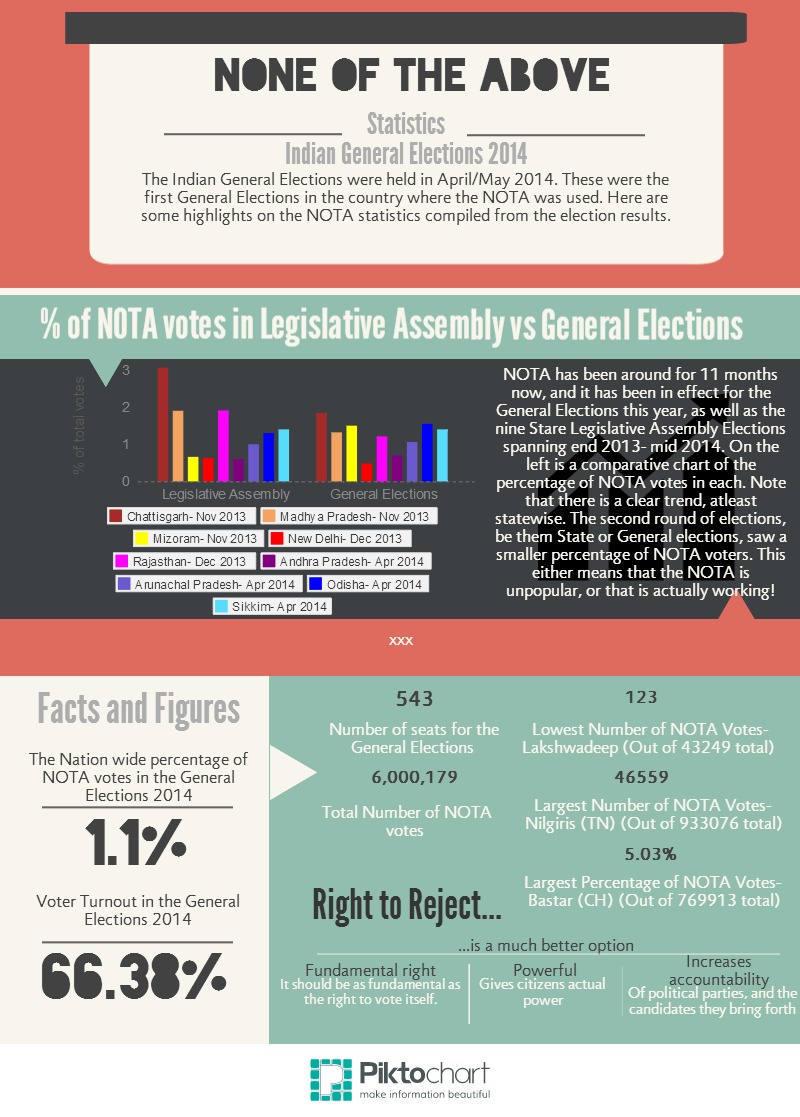
In the 2014 General Election, more than 6 million people used the NOTA. That is 1.1% of the 553 million voters, but represents a start. This small number means a number of things. One, that people are starting to become aware of the NOTA, but are probably unaware that it is as fruitless as signing a register , that people are aware of the NOTA option, but mistakenly think it is actually an RTR, casting their vote in futility. The most significant meaning of these 6 million NOTA votes is that 6 million Indians know their right to vote, and they are not going to sit at home to waste their vote. It also means that atleast 6 million people have difficulty in identifying with a political party and/or the candidates in their constituencies.
1% of voters voting for NOTA is a much better statistic, in my opinion, instead of an extra 1% that didn’t show up to vote. The voter turnout this year was 66%, a record, but could it not be that out of those 34% who didn’t show up to vote, some didn’t simply because they didn’t identify with any candidate?
NOTA is a big step for India. This is a big step in realising that Indians are clearly not apathetic, and slowly, but surely, we are waking up from the idealistic dream of a corruption free India, and are willing to show our leaders our displeasure towards them, pushing them to actually making our idealistic dream a reality.
The last elections forced the Supreme Court to introduce NOTA. Hopefully, in a few years, the Supreme Court will introduce RTR, and we will be proud to be represented by our ‘elected’ representatives.
 Note- I really want to spend some time on this analysis, especially comparing NOTA votes as a percentage of total votes to the number of candidates standing for the election. Elementary observation showed that areas with a larger number of candidates had fewer NOTA votes. This could extend into a debate by itself, because even though this reduces the ambiguity of the invalid votes, it means that the elected candidate is in fact, not THE ideal representative, because even though they are a minority, there are people who would much rather vote for other candidates. Yes, it’s impossible to please everyone, so we cannot expect a total majority in any case, and such is politics. But I believe, it is in following these minority trends, we may find the next big change in India. Due to the significant amount of time that will go into doing this, (and the fact that no one is paying me to spend time on this as of now) I am leaving it be for the time being.
Please do comment with your thoughts on this phenomenon!
-Sakshi Jain
 ✴︎ now this
Let’s have a conversation :)